
How to Read a Criminal Record? | Lawyer in Izmir
What is a Criminal Record?
A criminal record, or as it is commonly known, a police record, can be defined as a record containing a list of crimes committed by citizens.
You can apply by going to the nearest courthouse or using your e-government password. turkiye.gov.tr You can easily obtain your criminal record through this platform.
How to Read a Criminal Record?

If you have already been convicted of a crime, the paperwork becomes a bit more complicated, and the criminal record will contain a lot of letters and numbers that might initially seem meaningless. We have numbered the characters in the image above to make it easier to explain their meanings.
C: The "C" at the beginning of the record is an abbreviation for the sentence slip. It represents a summary of the given sentence or conviction.
- Numbers starting with 0069: In a criminal record, the ID is the unique identification information assigned to that file by the UYAP (National Judicial Network Project) system.
- 07.11.XX (Date Information): It refers to the date on which the crime in question was committed.
- XXX 1. ASLCM (Court Information): The abbreviation of the court that issued the sentence is given here. It is understood that the crime recorded in the criminal record was committed by the 1st Criminal Court of First Instance in XX province. ASLM is the abbreviation for Criminal Court of First Instance. AĞM or ACM means High Criminal Court.
- 201X/5X5 (File Reference Number): Those numbers are the main case number.
- 2012/11X1 (File Decision Number): Those numbers are the judgment numbers of the trial.
- 14/11/201X (Date of Confirmation): The date information provided here refers to the time period when the sentence became final.
- Law No. 5237 SA (Relevant Law): The abbreviation "SA" stands for "numbered," and the numbers preceding it are legal codes. Therefore, in this example, it is understood that the penalty was imposed under Law No. 5237, which is the Turkish Penal Code.
- 116/2 51 (Relevant Article): It is clear from this which article of the law we just identified is used to impose the relevant punishment. Article 116, paragraph 2, and Article 51 of the Turkish Penal Code are cited as the basis.
- 1Y8A H. (Sentence Duration): Here, the letter Y stands for "year" and the letter A stands for "month," indicating the duration of the sentence given to the defendant in the case in question.
- 01/10/201X (Date of Execution of the Decision)Here, the date on which the sentence was carried out is indicated.
No criminal record.
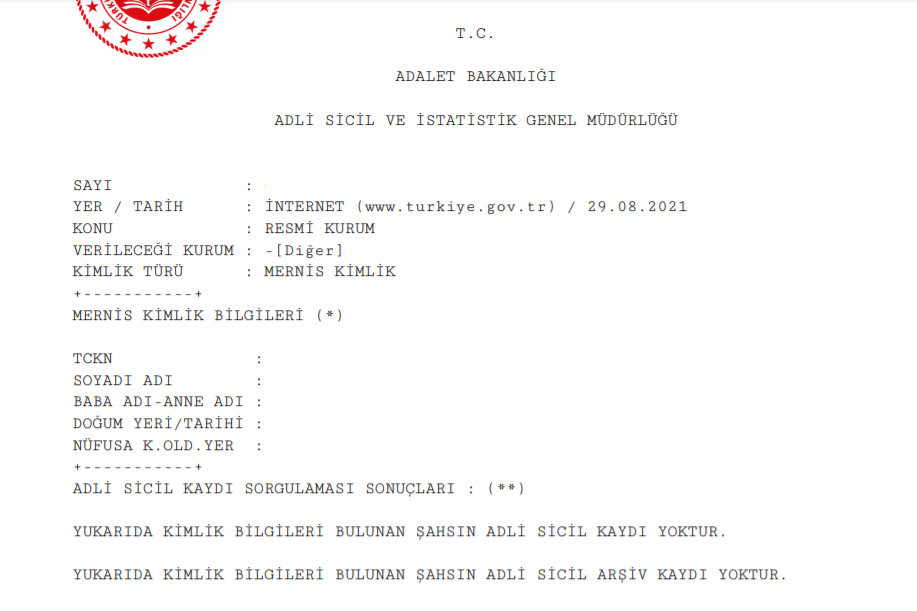
If your criminal record certificate, obtained through the e-government system or by applying to the relevant public institutions, states "NO CRIMINAL RECORD," this document means that you have not been previously convicted of any crime.
What is an Archive Record?

Archive records refer to criminal case files that were opened in the past and for which the legally specified period has passed. Archive records are not visible in criminal records provided to private institutions. “"There is no criminal record, but there is an archive record."” Such a statement would mean "no criminal record" but that the person has been convicted in the past.
Postponement of the Announcement of the Verdict & Deferment of the Commencement of the Case

Here, unlike the examples above, we have included an example of what the situation would look like if the defendant receives a suspended sentence (HAGB) or a postponement of the trial.
For legal advice on this matter, please contact our expert team. Contact page.
Other works that may be of interest to you;
- Crimes Subject to Expedited Trial
- Crimes Subject to Mediation
- Cases Requiring Compulsory Legal Representation
- What is a fine for violating a curfew? How can one appeal?
- HAGB (Suspension of the Pronouncement of the Verdict) and Postponement of the Prison Sentence
- Quick Trial Procedure in Criminal Procedure
- Objection to the Traffic Penalty
- Search Warrant
- The Crime and Punishment of Qualified Fraud
- What is a judicial fine?
- What does "defendant" mean?
- Crime of Obscenity
- Search Warrant
- What is conscious negligence?
- Threat Crime & Punishment
- What is the crime of looting?
- Breach of Trust Crime
- What is acquittal?
- How long do criminal trials last?
- What is the presumption of innocence?
- Types of Prisons
- Crime of Forgery of Documents
- International Bulletin
- What is a Medical Report? How to Obtain One?
- Is it legal to carry a blank-firing pistol?
- What is stalking?
- Administrative Responsibility Due to the Earthquake
- Harassment via Social Media
- Instagram Account Hacking Under the Turkish Penal Code
- Creating a Fake Instagram Account Under the Turkish Penal Code
- What is a repeat offence?
- What are cataloged crimes?
- Factors Affecting Defectiveness
- What does "complainant" mean?
- Penalties for Drunk Driving
- What is GBT?
- Expedited Trial Procedure
- What is the crime of insult?
- Illegal Gambling Crime
- What is confiscation?
- Prevention Search
- The Crime of Insulting Religious Values
- What is HAGB?
- Inciting hatred and hostility or humiliation among the public
- Arrest Warrant
- What is Dismissal of a Case?
- How to Read a Criminal Record?
- Filing a Criminal Complaint with the Prosecutor's Office
- What is the Right to Remain Silent?
- Crime of Using Narcotic and Stimulant Substances
- Conspiracy to Commit a Crime
- Discretionary Reduction in Criminal Proceedings
- Detention
- The Crime of Stalking
- Is Carrying a Knife Forbidden?
- Perjury

Address: Nergis Neighborhood, Girne Boulevard No: 83, Floor 2, Apartment 2, Karşıyaka, İzmir
E-mail: info@efeshukuk.com
Phone: +90 534 415 52 56